


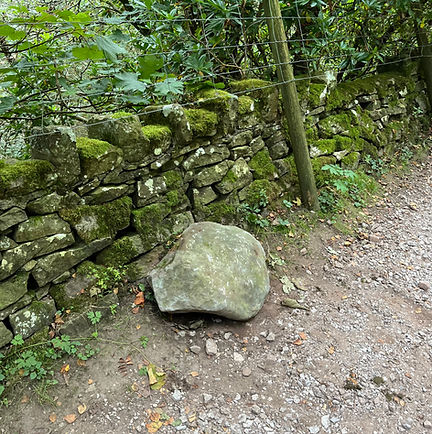
Nook Stone
Weight
131kg / 289bs
Location
View on Google Maps
View on what3words - familiar.forklift.freezers
Original Challenge
Stone to Chest
Name Origin
The word nook comes from Old English noc, meaning a corner, recess, or secluded spot. It also connects to the Old Norse hnúka, meaning a projecting hill or crag—a likely influence given Viking presence in Lancashire. In British placenames, “nook” often denotes a small valley, a corner of land, or a sheltered hollow beside a hill.
Stone Submission
Discovered in situ by @dances_with_stones below the drystone wall to the side of the path below the Nicky Nook Fell 100m up the path from its sister stone - the Nicky Stone.
History
The Nook Stone takes its name from the sheltered folds, or "nooks", that characterise the landscape beneath Nicky Nook Fell. While the fell itself dominates the skyline, the lower ground around Grizedale Brook has provided pasture and shelter for livestock for centuries.
During the Viking Age (c. AD 800–1066), Scandinavian settlers established farming communities across Lancashire, leaving behind many of the Old Norse place names still found throughout the Forest of Bowland and surrounding villages.
By the medieval period, the area formed part of the Royal Forest of Lancaster, where farming and grazing shaped the landscape for generations.
In the 17th and 18th centuries, scattered farms around Scorton and the Wyresdale valley relied on the fertile land and watercourses flowing from the fell. The nearby tracks were used by farmers, drovers and local workers moving livestock and goods between villages.
Today, the peaceful setting around Grizedale Brook is popular with walkers exploring Nicky Nook and the wider Forest of Bowland. The Nook Stone continues this connection with the landscape, offering a modern lifting challenge in a place shaped by centuries of rural life and local history.
Access and Permissions
This stone is located on open-access land. Public access rights apply subject to any restrictions or exclusions applicable to the site. These rights do not automatically grant permission to move, alter or place stones. Users should ensure that any lifting is compatible with the applicable access rights and restrictions and leave the stone and surrounding area as they found them.
Please read our Stonelifting Policy before attempting to lift this stone. The policy sets out the requirements regarding access, permissions, safety, conservation and responsible lifting.
